Overcoming Flight Phobia and Reclaiming the Freedom to Fly
As a therapist that treats anxiety disorders for a living, I’ve had the opportunity to work with a handful of people who have experienced a range of flight phobias, from mild anxiety to full-on panic attacks midair. For some it looks like experiencing anxiety weeks prior to a flight date and for others it looks like cancelled trips and missed opportunities.
Fortunately, I’ve developed a method of treating flight phobia that has helped many clients reclaim their space and time in the friendly skies. What’s most special and heartwarming to me is to get to witness how once this fear is conquered, a whole new world opens up for them, quite literally. No longer trapped, the broad expanse of this planet is available to them, in a word: freedom.
Understanding Flight Phobia
Flight phobia, clinically known as aviophobia or aerophobia, is a serious mental health condition that can trigger intense maladaptive physical and emotional responses. Physical symptoms often include rapid heartbeat, sweating, trembling, shortness of breath, nausea, and dizziness. Psychologically, individuals may experience racing thoughts about catastrophic disasters, out of control or doom and overwhelming dread. These symptoms high jack one’s central nervous system and broadly steal from their quality of life.
The Real Impact on Lives
Not dealing with a fear of flying comes at a cost: missed work trips, vacations, an opportunity to explore or relax, attend a graduation ceremony, a wedding or a funeral. In short, flight phobia can steal from your opportunity to partake in your own life and limit your ability to live your life to the fullest.
Using a conglomerate of techniques I’ve learned in counseling school, I created a method that helps clients regain control of their minds and bodies while flying, so they can go places, live life, and not be ripped off by their fears any longer.
Sarah’s Story: Three Years Grounded
Sarah (name changed for privacy) was one of my very first clients; she came to my office after three years of no vacation and no air travel. Red flag, I noted… “What’s this about?,” I asked. As it turns out, Sarah’s fears were deeply rooted not only in anxiety, but in a specific type of childhood medical abuse called Fictitious Disorder Imposed by Another (FDIA); basically her mom had convinced her as a child that she would physically die or suffer irrevocable injury if she were to partake in certain activities. This led the client into a particular type of developmental trauma – growing up believing in her own catastrophic thoughts, until she realized how untrue they were in therapy.
To complicate this case, Sarah was adamantly against taking any prescription medications, so Sarah was going to “raw-dog” these flight fears with a combination of seven empirically-researched therapies: Attachment-Based Therapy (ABT), Cognitive Behavioral Therapy (CBT), Dialectical Behavioral Therapy (DBT), Exposure Therapy (ET), Mindful Self-Compassion (MSC), Somatic Therapy (ST), and psychoeducation.
I’ll never forget how giddy she sounded on the phone after completing her first international trip. She was so ecstatic to be able to fully live life again, to take a vacation, and enjoy time with friends. She even came back with a tan!
Maria’s Mid-Flight Panic
Maria (name also changed) flew back and forth across the Pacific Ocean for both work and leisure several times a year. However, having a panic attack mid-air was not on the itinerary. She came to therapy with an urgent need to fix this problem as soon as possible so that she could live her life again. Through therapy, I learned Maria’s anxiety stemmed from childhood medical neglect and childhood sexual abuse. Students of trauma will understand how Maria just needed to feel safe and contained; everything was going to be alright.
Open to the idea of as-needed medications, Maria found that having an anti-panic medication to take before boarding the plane alongside researched tools really helped her be able to stay calm and enjoy her next flight. We used empirically-researched modalities such as Attachment-Based Therapy (ABT), Cognitive Behavioral Therapy (CBT), Dialectical Behavioral Therapy (DBT), Exposure Therapy (ET), Gottman Method Couples Therapy, Mindful Self-Compassion (MSC), Somatic Therapy (ST), and psychoeducation. Notice how this time we used Gottman Method Couples Therapy as well. That’s because as it turned out, her husband would have a significant role to play in co-emotional regulation.
Sometimes we just need a little help from our friends. And to remind our spouses that yes, they are supposed to behave as a friend at all times, including eight miles above sea-level.
The Treatment Approach: A Personalized Path to Confidence
The genesis of most anxiety stems from trauma or maladaptive beliefs. There isn’t a one sized fits all therapeutic approach to treating flight phobia, but there is a one size fits most approach.
Taking the First Step
If you’re struggling with flight phobia, know that you don’t have to face this alone, and you don’t have to let fear make decisions for your life. The fear is real, the anxiety is real, but so is the possibility of change.
No matter what you’re dealing with there’s only one thing you cannot do any longer: nothing.
That’s right, you have to do something, pick up a workbook, a course, talk to a friend or a licensed therapist about how to deal with your flight anxiety so that your next flight can actually be somewhat enjoyable.
Beyond Flying: The Ripple Effects
What I’ve observed in my practice is that successfully overcoming flight phobia often has ripple effects in other areas of life. Clients report feeling more confident in facing other challenges, more empowered in their ability to manage anxiety, and more optimistic about possibilities they’d previously written off as impossible.
Sarah, who hadn’t flown in three years, didn’t just gain the ability to travel—she gained confidence in her capacity to change deep rooted patterns that felt unchangeable. Maria, who dreaded flying over the Pacific Ocean, didn’t just learn to manage panic attacks—she learned that she could be present and peaceful even in situations that once terrified her.
Your Freedom Awaits
Your fear of flying is temporary. With the right support and effective strategies, you can take back the reins of self-control and explore the world by air again. The sky’s the limit (tada-ching!). If you want to learn to maneuver through airports and cabins with greater ease, reach out using links at the top of this page.
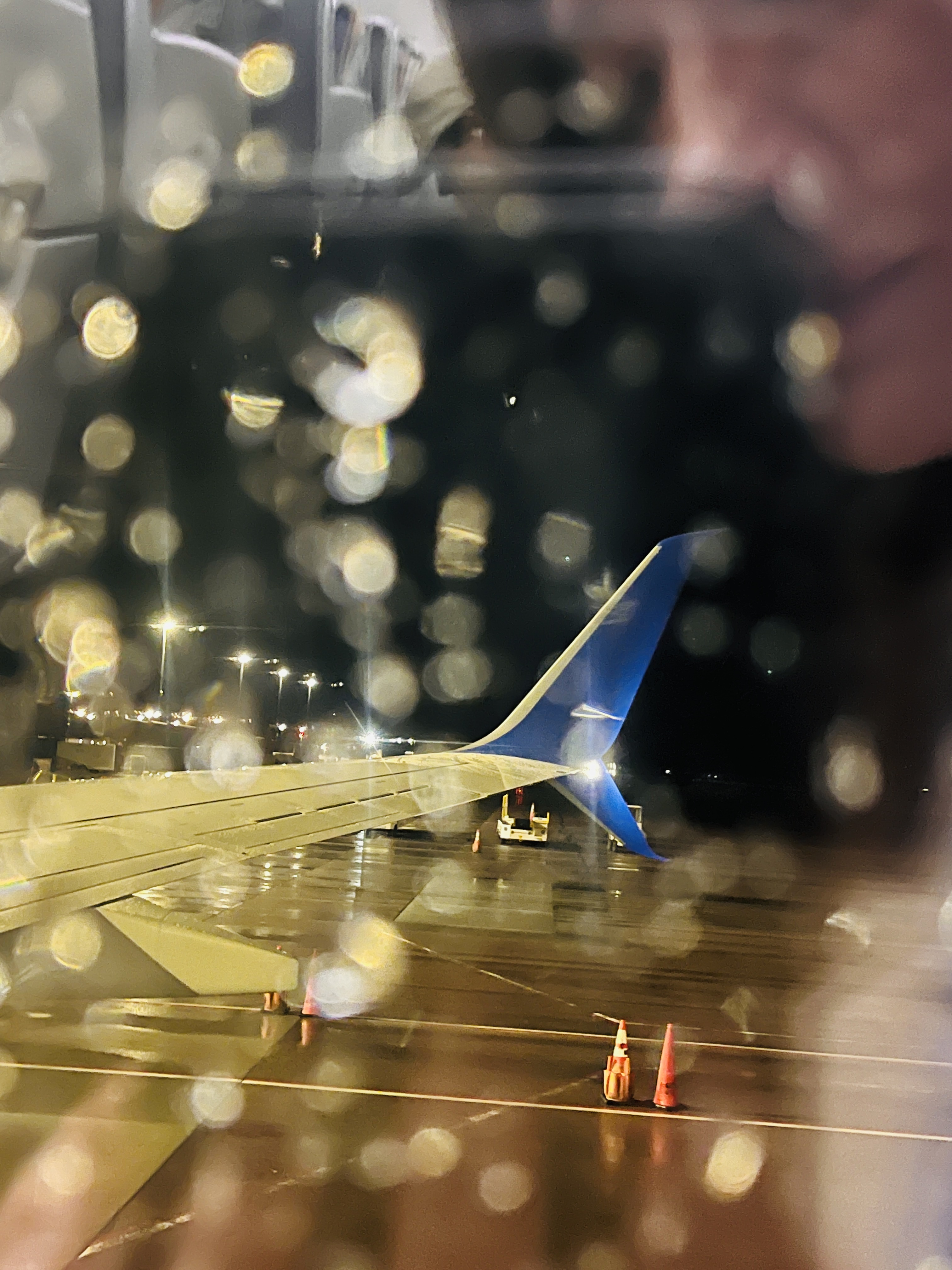
This photo is available for purchase on Saatchi Art:
https://www.saatchiart.com/print/Photography-Self-Portrait-No-2/2074037/13435307/view
There’s a lot going on here. I was waiting for take off at Glacier International Airport (FCA) in Kalispell, Montana when it started raining. Passengers were still getting settled in their seats, which you can see with the man in the ball cap in the back, the rain blurred and reflected as sparkling Christmas lights (it was December after all), then there’s the slickness of melted snow on the wet runway, orange cones lined up… Here I was trying to find a single moment of solace, of quiet, a deep breath, a moment of zen (haha), in capturing a single frame, but ended up with a cacophony, a juxtaposition four different things: the activity of the runway, the hustle and bustle inside the cabin, and the weather weathering as rain on the window pane, and me.

To schedule a consultation or learn more about treatment for flight phobia or other anxiety-related concerns, please contact Clearwater Counseling Services, llc. Your journey to overcoming fear and embracing freedom starts with a single step— or in this case, a single form or phone call.
Leave a Reply